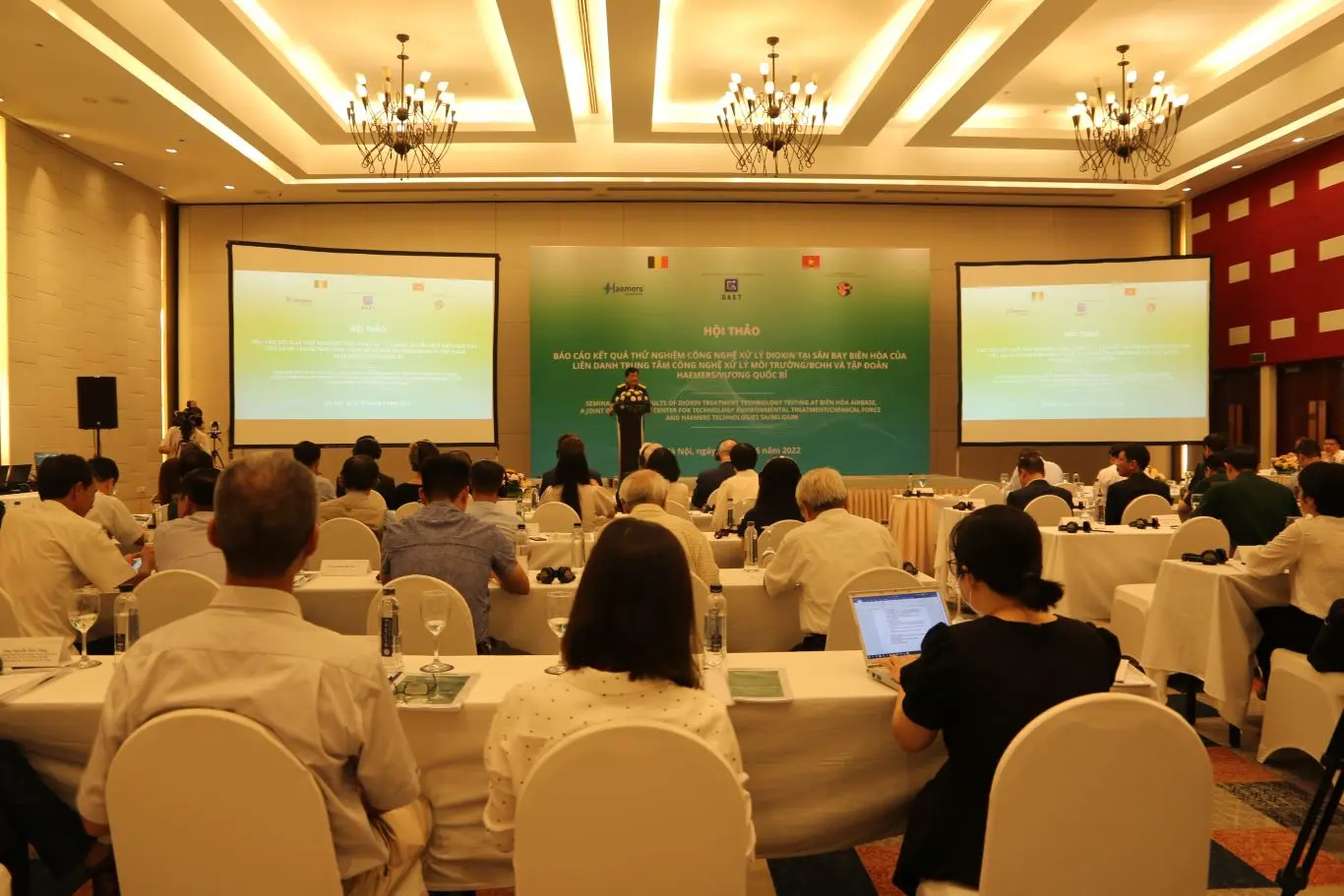
On June 15, 2022, in Hanoi, Haemers Group/Belgium (HT), the Center for Environmental Treatment Technology/Chemical Corps (CTET), and the General Corporation of Defense Industry Economic and Technical Services (GAET)/General Department of Defense Industry jointly organized a workshop to report on the results of testing dioxin treatment technology at Bien Hoa Airport.
The workshop was attended in person and online by nearly 70 guests, including representatives from agencies under the Vietnamese Ministry of National Defence, the Ministry of Natural Resources and Environment, the Ministry of Science and Technology, the Belgian Embassy in Vietnam, representatives from the Japan International Cooperation Agency (JICA), the United States Agency for International Development (USAID), and representatives from agencies, organizations, and businesses in Vietnam and Europe, along with contributions from scientists and researchers in the field of environment and dioxin contamination remediation in Vietnam.
During the Vietnam War, millions of liters of herbicide were sprayed across Vietnam: sedatives. This poison was used in Operation Ranch Hand to destroy crops and forests. Bien Hoa Air Base was a joint operational location of the South Vietnamese Air Force and the US Air Force.
Agent Orange has been shown to cause serious health problems, including birth defects, neurological problems, and cancer. Dioxin is a highly toxic organic pollutant that persists in the environment for a long time. More than four decades after the end of the war (1975), dioxin continues to have a significant impact on humans and living organisms. Many measures have been implemented to improve people's living conditions, starting with the treatment of dioxin-contaminated soil.
In 2018, CTET and HT signed a cooperation agreement to conduct a pilot project demonstrating the effectiveness of thermal desorption technology for dioxin-contaminated soil at Bien Hoa Airport. A key objective of the pilot project was to demonstrate the effectiveness of the Smart Burners™ design and technology in treating dioxin-contaminated soil to target dioxin and furan levels at specific locations, specifically reducing contamination levels to below 300 ppt TEQ.
Therefore, Haemers Technologies designed an experimental heat treatment system comprising two main components: a 237 m³ heating pit containing three types of materials for treatment: 187 m³ of contaminated soil, 25 m³ of contaminated soil sludge, and 25 m³ of eluted soil cake; and a steam treatment unit for dioxin destruction consisting of a thermal oxidizer, which produces no liquid or solid waste.
The testing activities were initiated by HT in early 2020; however, by the end of March 2020, HT was forced to leave the site and cease operations due to social distancing regulations caused by the COVID-19 pandemic. At the end of December 2021, after nearly two years of interruption, HT returned to the site, restarting testing activities as per the agreement between the parties. The official treatment phase began on February 2, 2022, and concluded on March 14, 2022, after 40 days of treatment. The target temperature of 335 ° C was achieved and maintained in the abutment for 5 days.
Post-treatment evaluation results showed: The soil could be heated to 335°C in less than 40 days; all dioxins were destroyed; emissions fully met Vietnamese, EU, and US standards; there were no unusual leaks during treatment; ambient air monitoring parameters met standards; the treatment phase did not generate waste (no liquid or solid waste was produced); the concrete covering the entire stubble was proven to be uncontaminated and fully recyclable; destruction efficiency was >99% and target treatment concentrations were achieved, and the treated soil is reusable.
Experimental testing has demonstrated that heat treatment technology for dioxin-contaminated soil is an advanced and effective solution, with all toxic components destroyed and the soil reusable for various purposes.
Based on the discussions and contributions from experts and guests attending the workshop, CTET and HT will collaborate to finalize a report for the Vietnamese Ministry of Defence, USAID, and relevant agencies to consider applying the tested thermal desorption technology as the primary and effective technology for treating dioxin-contaminated soil in Vietnam.
Hong Nhung